Indoor Air Quality in a Humid Houston-Area House
Air purifiers, UV lights, filters and dehumidifiers solve different problems, and in this climate humidity usually comes first.
October 20, 2026 · 3 min read
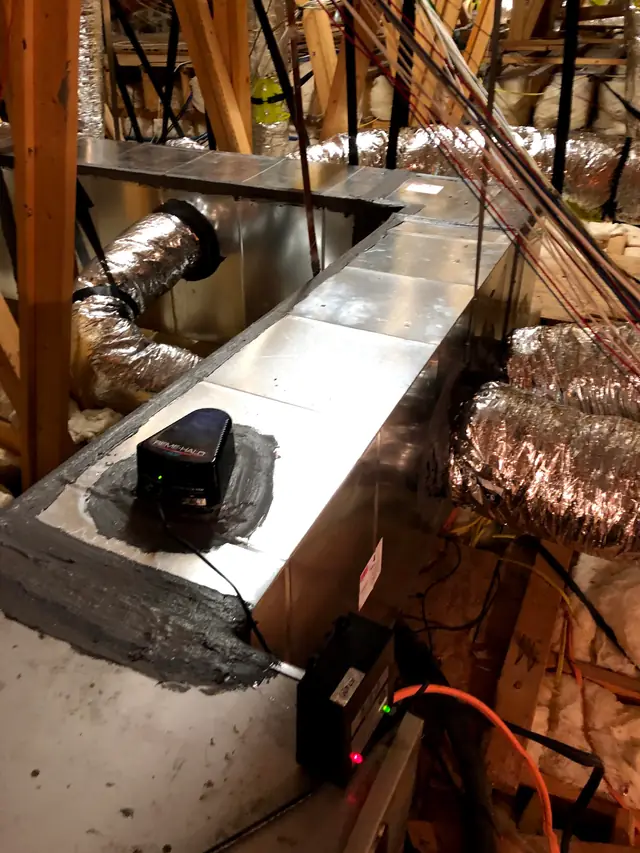
Indoor air quality products come with a lot of claims, and the product names don't make it easier. Purifier, cleaner, scrubber, ionizer: they sound alike, and they work in very different ways. Here's a plain look at what each type of equipment is designed to do, so you can tell which problem each one solves.
One note up front. This is a trade overview of equipment, not medical advice. If you have a health concern, talk to your doctor.
Start with humidity
In the Houston area, humidity is the first thing to look at. A house that feels clammy, with a musty smell or windows that fog, usually has a moisture problem that no filter will fix. Your air conditioner removes moisture as it cools, but only while it's running, and a system that short-cycles or is oversized for the house can leave the air damp.
A whole-house dehumidifier ties into the duct system and pulls moisture out of the air independently of the cooling cycle. It's designed to hold humidity at a comfortable level without overcooling the house. In dry winter weather, a humidifier does the opposite job.
Filters: the baseline
Every system has a filter, and it's the most basic form of air cleaning. A standard filter mainly protects the equipment from dust. Media filters in a cabinet, like the Honeywell media cabinet in one of our attic photos, have more surface area and catch finer particles.
A denser filter isn't automatically better. If your blower and ductwork weren't built for the extra resistance, a restrictive filter cuts airflow, and that hurts the system. Match the filter to the equipment, and change it on schedule.
Air cleaners that handle the whole house
Whole-house air cleaners mount in the duct system and treat all the air that passes through. Several types are available:
- Media air cleaners, such as the Aprilaire models we install, trap particles in a deep filter
- HEPA air cleaners use very fine filtration
- Electronic air cleaners use an electrical charge to collect particles
- UV lights, including UV coil purifiers, are designed to treat the surface of the coil, or the air passing it
Each is designed to reduce airborne particles or treat surfaces inside the system. What you want from the equipment determines which makes sense.
What a REME HALO does
The photo with this post shows a REME HALO air purifier installed in a supply plenum in an attic, with the connection sealed with mastic. It's an in-duct unit designed to treat air as it moves through the system, and mounting it in the supply plenum puts it where all the conditioned air passes.
Like any product in this category, it's designed to do a specific thing, and the manufacturer's literature is the right place to read exactly what it's rated for. We're comfortable describing what the equipment is designed to do. We won't promise health outcomes from it, and you should be wary of anyone who does.
Ventilation: bringing in fresh air
Modern homes are built tight, which saves on energy but leaves stale air in the house. Ventilation systems bring in outside air on purpose. In a humid climate, that's a problem, because outside air carries moisture.
An ERV, or energy recovery ventilator, and an HRV, or heat recovery ventilator, are designed to exchange air between inside and outside while recovering some of the energy. An ERV also handles moisture transfer, which is why it's the one usually discussed for humid climates. Whether a house needs one depends on how it's built.
Testing before buying
It helps to measure before spending money. Air quality testing looks at conditions in your home, and depending on the instrument that can include particles, humidity and carbon dioxide. Results help narrow the field: if the main issue is moisture, a dehumidifier does more than a purifier.
Sorting out where to begin
A reasonable order for most houses in this area looks like this. Get the humidity under control. Make sure the filter fits the system and is changed regularly. Seal and clean the ducts if they're leaking or dirty. Then consider an air cleaner or UV treatment for the specific concerns you have.
Buying a purifier first and ignoring a humidity problem is the common mistake, because the purifier won't dry out the house. Equipment that's designed to clean air can't do the job of equipment designed to remove moisture, and the reverse is true too. Matching the product to the problem is most of the work.
Crossway installs filters, air cleaners, UV lights, ventilation, humidity control and air quality testing. See /services/indoor-air-quality or call 832-250-6191.
Crossway Mechanical, 832-250-6191
Call 832-250-6191More articles
What Superheat and Subcooling Tell You About Your AC
Two numbers on a technician's tablet say more about your system's charge than any guess ever will.
Getting a Second Opinion When Someone Says Your Compressor Is Bad
A compressor replacement is one of the biggest repairs an AC can need, and it's fair to ask for proof first.