What Superheat and Subcooling Tell You About Your AC
Two numbers on a technician's tablet say more about your system's charge than any guess ever will.
October 20, 2026 · 4 min read
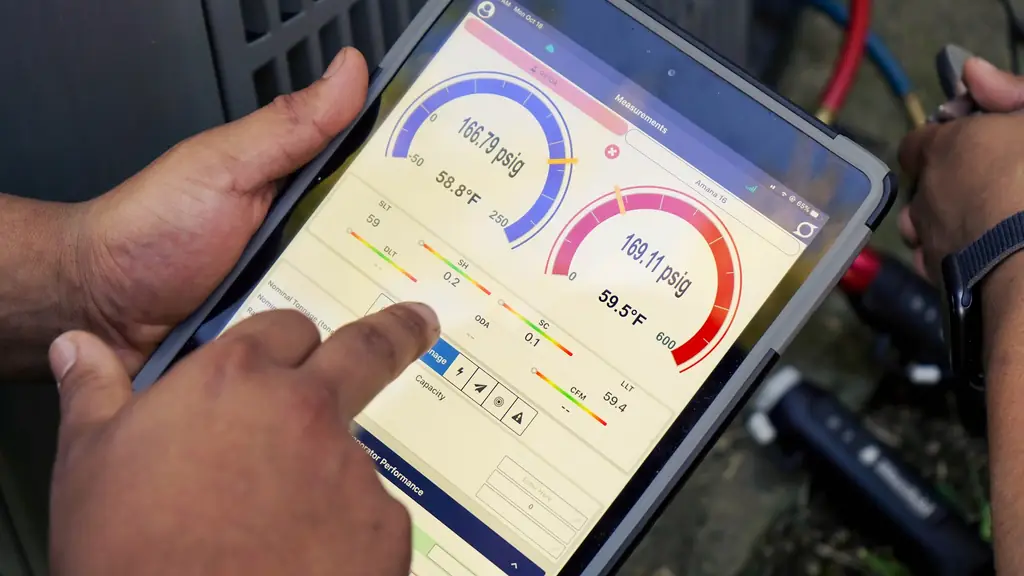
If you've watched a technician work on your air conditioner lately, you may have seen a tablet or a set of gauges covered in numbers. Two of those numbers matter more than the rest: superheat and subcooling. Together they tell a technician whether your system holds the right amount of refrigerant, and whether that refrigerant is doing its job.
They're easier to understand than they sound. Let's use a real reading from one of our service calls to walk through it.
The reading in the photo
The tablet at the top of this post is running the iManifold app, a digital manifold that reads pressures and temperatures from the refrigerant lines. This is an Amana 16 system on R410A. The screen shows a suction pressure of 166.79 psig at 58.8°F, and a liquid pressure of 169.11 psig at 59.5°F. The suction line reads 59°F, the liquid line 59.4°F, and the app calculates superheat at 0.2 and subcooling at 0.1.
Those last two numbers are the ones to understand. Here's what each one means.
What superheat is
Inside your indoor coil, liquid refrigerant boils into vapor as it soaks up heat from your house air. Every pressure has a matching boiling temperature. Superheat is how many degrees warmer the vapor leaving the coil is than that boiling temperature.
A technician finds it by reading the pressure on the suction line, converting that to a boiling temperature, then clamping a thermometer on the line and subtracting. Too little superheat can mean liquid refrigerant is travelling toward the compressor, which isn't built to pump liquid. Too much can mean the coil isn't getting enough refrigerant to do its full job.
What subcooling is
Subcooling is the same idea at the other end of the loop. The outdoor coil gives up heat and the refrigerant condenses from vapor back into liquid. Subcooling is how many degrees cooler that liquid is than its condensing temperature.
A solid column of liquid at the metering device is what the system needs. Low subcooling can point to a system that's short on charge. High subcooling can point to too much refrigerant, or a restriction somewhere in the liquid line.
Why the numbers in the photo sit so close together
Look at the two pressures again: 166.79 and 169.11 psig. They're about two pounds apart. In a running R410A system the suction and liquid sides are normally far apart, usually by hundreds of psi.
Pressures this close together mean the refrigerant has equalized, which is what happens when the compressor is off and the system has been resting. With equalized pressure the refrigerant sits near the same temperature everywhere, so superheat and subcooling both read close to zero. That's exactly what 0.2 and 0.1 are.
So the photo isn't a verdict on that system's charge. It's a frame from the middle of a job, with the tool connected and the technician getting ready to read the system under load. That's worth knowing, because it shows why the timing of a reading matters.
Why a charge has to be proven while the system runs
A real charge check happens with the system running steadily, with a clean filter, a clean outdoor coil and normal airflow. The technician waits for the pressures to settle, then compares the readings to the manufacturer's target for that model and the temperatures that day.
Some systems are charged to a target superheat and others to a target subcooling, depending on the type of metering device. The data plate or charging chart for your unit says which one applies. A technician who knows the target and shows you the measured number is doing the job properly.
Why guessing a charge goes wrong
It's tempting to judge a charge by one gauge pressure, or by whether the coil feels cold. Pressure alone moves with the outdoor temperature, so a single number tells you very little. Airflow problems such as a dirty filter, a dirty coil or undersized ductwork can also look like a charge problem, and a technician who only watches pressure can end up adding refrigerant to a healthy system.
And a system that really is low on refrigerant has a leak, since refrigerant isn't used up like fuel. Adding more without finding the leak is a temporary fix at best. Measured readings help separate those cases.
What to ask your technician
- What are the suction and liquid pressures, and what boiling and condensing temperatures do they match?
- What are the superheat and subcooling, and what does the manufacturer list as the target for this unit?
- Was the system running steadily when you took the readings?
- Did you check the filter, the coil and the airflow first?
You don't need to read the gauges yourself. A good technician will gladly show you the screen and explain what each number means, and that's a good sign about the whole visit.
Measured, not guessed
This is how we work at Crossway Mechanical. The readings come from a digital tool, they're compared to what the equipment calls for, and the charge is set from the numbers instead of from a hunch. It takes a little longer than topping off by feel, and it's the only way to know the system is right when we leave.
To have your system's charge checked with real readings, see /services/air-conditioning or call 832-250-6191.
Crossway Mechanical, 832-250-6191
Call 832-250-6191More articles
Getting a Second Opinion When Someone Says Your Compressor Is Bad
A compressor replacement is one of the biggest repairs an AC can need, and it's fair to ask for proof first.
What the $15 a Month Preferred Service Agreement Covers
Here's every benefit published in the Preferred Service Agreement, with a plain explanation of what each one means for you.